How Science gives Nature a helping hand
 |
Reproduced from the

Medicine can work wonders,but as Professor Robert Winston's latest series reveals,doctors still have a lot to learn from the human body.
E Jane Dixon
When Professor Robert Winston talks
about the human body, something like reverence softens his professionally
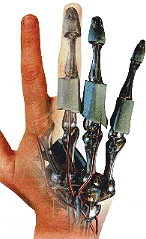
abrupt manner. Describing the intricacies of a pioneering hand transplant,
he turns his own hand slowly in the air, as if displaying a rare and fabulous
piece of kinetic sculpture.
"Our capacity for wonder," says Winston, regretfully pocketing the exhibit,
"is the whole reason for science. When you stop wondering, you probably stop
producing good science."
This sense of the marvellous is the driving force behind
Superhuman,
a major new series for BBC 1 that starts next week. Winston is our guide
on a whistle-stop tour of the human body's extraordinary resources and its
literally fatal flaws.
Within its six instalments the series explores many ground-breaking medical
advances, from those that embrace new technology-driven solutions to those
that harness the power of nature itself to seek, and sometimes effect, a
cure. At its heart the series marvels at the
body's capacity for self-repair and at how medical intervention can
accelerate that process.
"The real argument of the series is that often the body knows
better than the doctors, and that doctors would do well to understand the
basic science and improve their knowledge of how to help the body to heal
itself," says Winston.
Perhaps the most startling examples of this swing away from modern
interventionist medicine are the case histories outlined in next Tuesday's
opening programme about recent breakthroughs in trauma medicine - the treatment
of serious injury. There is compelling new evidence that, left to its own
complex devices, the body will deploy some remarkably effective defence
strategies. It is now thought that even the simplest intervention - such
as pumping fluids into the injured body to restore blood pressure - may upset
the natural recovery process.
"In the Vietnam War, people actually died because the medical
treatment was too quick," Winston points out. "Had doctors allowed some of
the very seriously injured soldiers to recover on their own, lying on the
battlefield, they might actually have got better. This is what happened in
the Falklands War, where night battles and bad weather meant quick recovery
of casualties was too dangerous. Because medical teams couldn't get to them,
and because of the extreme cold, which slows down the effects of trauma,
many terribly wounded soldiers did in fact survive.
While Superhuman will celebrate technological procedures
that our parents never dreamed of- watch a child's face as he hears voices
for the very first time following a cochlear implant - Winston warns that
technology has also set our bodies at dangerous odds without environment.
"Quite a lot of the time, we bring medical disasters upon ourselves," he
explains. "In the programme dealing with infection [Killers into cures],
we point out that by giving people antibiotics when they were children, we
have probably increased asthma, which is now an epidemic. Again and again
we come back to this mechanistic approach to medicine.Just today there was
a report about an artificial heart - well, yes, that may work, but we could
be doing much more to promote a harmony between ourselves and nature that
would reduce the incidence of heart disease in the first place."
Many of the procedures described in Superhuman are likely
to spark controversy. The technique of treating Parkinson's disease by
transplanting the brain cells of pigs into humans, for example, and the
world-famous mouse with the human ear grown on its back, are flashpoints
for animal-rights activists. This is something
Winston takes very seriously: "We scientists have tended to go very quiet
about animal research, but I believe very firmly that if you don't
engage in a debate, you lose it. I think there is a very serious threat in
this country to bio-technology and bio-medical research from people who want
to see all animal research banned. "Animal research is vital for human
health.
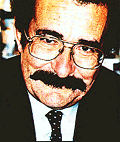 |
| Professor Robert Winston explores natural defences and scientific advances |
[Animal testing is highly dangerous,results are spurious,the
problem with Thalidomide happened
in part because of animal testing.Animals bodies are not the same as ours,
and react differently to different substances,it is therefore absouletly
mad to use them as a testing ground for what will be used on ourselves -LB]
Without it we wouldn't have new cancer treatments, we wouldn't have modern
surgical practice or the ability to fight bacteria, we wouldn't have transplants.
By the same token, our humanity is diminished if we don't treat other species
with respect. Scientists, like myself, who do animal research have
a great respect for animals. But as long as we,
as a society, are wearing leather shoes and eating meat, there is no excuse
for giving way to people who feel that all animal research is immoral.
It's not immoral. We must use animals
wisely, we must use them humanely, but their use is essential for human
wellbeing."
As a Labour peer who rose to prominence for his pioneering
work in the field of fertility treatment - the walls of his office are covered
with photos of infants he has helped into the world - Winston is intimately
connected with the ethical debate over how far doctors should go in pushing
the boundaries of human biology.
To critics, issues such as altering the sperm of newborn babies to prevent
genetic disorders being passed down the family line, and therapeutic cloning,
have dangerous echoes of the eugenics experiments practised in Nazi death
camps. It's an idea that Winston, who is Jewish, energetically refutes.
"That notion of genetics, which comes into the last programme only slightly,
does have those echoes, if only to discard them," he explains. "We're in
the 21st century, and I think what happened half way through the 20th century
doesn't have the same resonance. I didn't feel there was a need to be
sensitive about that."
The frequently heard assertion that medical scientists are
"playing God" with human life has him practically stamping with
irritation: "It's just nonsensical," he says. "If you believe, as I do, that
human intelligence is God-given, then not to use that intelligence, actually,
is unethical. We're not trying to change creation, what we're trying
to do is use what God has created to enhance, prove and protect human life."
There is no doubt that Superhuman will raise as many questions
as it answers. "That," says Winston, "is the nature of
science."
Appliance of science
|
 COLD COMFORT

Letter to the Radio Times
 |
Date: 26/06/98 16:30
Dear Editor, With the end of Professor Robert Winston's excellent series
The Human Body also came the end of a human life,that
of Herbie,who bravely decided to show his death on
TV.
With this programme Professor Winston sought to show that we are
dying from the moment we are
born,and that we should face death with less moroseness since via a
scientific view,we live on,at least in a physical sense,as he correctly stated
via the re-use of our atomic components, but the person may only live on
in memory.
But previously in the series he had alluded to a religious
sense of soul,and in Herbie's programme,people alluded to being nearer
to God when close to death.As a scientist Professor
Winston gives us valuable information about what we are as physical beings,but
by allowing Religion to creep into the picture,this mars an otherwise edifying
view of death as less than a complete loss.
Personal beliefs are nothing to do with science,and
the nature of the thing alluded to as "soul"
can be explained by he emergent behaviour of the brain,in very much the way
that Professor Winston explained the tunnelling effect near death.Thus Religion
has no place in a programme about "The Human Body".
Even if the programme had been called The Human Spirit it's role would
still have been dubious.More to the point,for a scientist to show that he
has a Jewish faith on national television helps to undermine the very interesting
information that Professor Winston has shown as a scientist.
Religion and Science as Professor Lois Wolpert and
Professor Richard Dawkins rightly say,are antitheses
of one another, and should not appear as if they are in any way
connected.Religion is belief by faith,Science
is knowledge by experiment,and for Robert Winston to blur the boundary
is unhelpful,especially in a series that seems to have been lauded for it's
engaging commentary,light humour, intelligence,and technical capability.
Yours sincerely,
| Robert Pirsig "Zen and the Art of Motorcycle
Maintenance"[p421].Robert explains his son's death without referring
to the supernatural......
I tend to become taken with philosophic question, going over
them and over them and over them again in loops that go round and round and
round until they either produce an answer or become so repetitively locked
on they become psychiatrically dangerous, and now the question became obsessive:
'Where did he go?' Where did Chris go? He had bought an airplane ticket that
morning. He had a bank account, drawers full of clothes, and shelves full
of books. He was a real, live person, occupying time and space on this planet,
and now suddenly where was he gone to? Did he go up the stack at the crematorium?
Was he in the little box of bones they handed back? Was he strumming a harp
of gold on some overhead cloud? None of these answers made any sense. It
had to be asked: What was it I was so attached to? Is it just something in
the imagination? When you have done time in a mental hospital, that is never
a trivial question. If he wasn't just imaginary, then where did he go? Do
real things just disappear like that? If they do, then
the conservation laws
of physics are in trouble. But if we stay with the laws of physics, then
the Chris that disappeared was unreal. Round and round and round. He used
to run off like that just to make me mad. Sooner or later he would always
appear, but where would lie appear now? After all, really, where did he go?
The loops eventually stopped at the realization that before it could be asked
'Where did he go?' it must be asked 'What is the "he" that is gone?' There
is an old cultural habit of thinking of people as primarily something material,
as flesh and blood. As long as this idea held, there was no solution. The
oxides of Chris's flesh and blood did, of course, go up the stack at the
crematorium. But they weren't Chris. What had to be seen was that the Chris
I missed so badly was not an object but a pattern, and that although the
pattern included the flesh and blood of Chris, that was not all there was
to it. The pattern was larger than Chris and myself, and related us in ways
that neither of us understood completely and neither of us was in complete
control of. Now Chris's body, which was a part of that larger pattern, was
gone. But the larger pattern remained. A huge hole had been torn out of the
center of it, and that was what caused all the heartache. The pattern was
looking for something to attach to and couldn't find anything. That's probably
why grieving people feel such attachment to cemetery headstones and any material
property or representation of the deceased. The pattern is trying to hang
on to its own existence by finding some new material thing to center itself
upon. Some time later it became clearer that these thoughts were something
very close to statements found in many 'primitive' cultures. If you take
that part of the pattern that is not the flesh and bones of Chris and call
it the 'spirit' of Chris or the 'ghost' of Chris, then you can say without
further translation that the spirit or ghost of Chris is looking for a new
body to enter. When we hear accounts' of 'primitives' talking this way, we
dismiss them as superstition because we interpret ghost or spirit as some
sort of material ectoplasm, when in fact they may not mean any such thing
at all. |