|
How it works : Amino Acids |
AMINO ACIDS
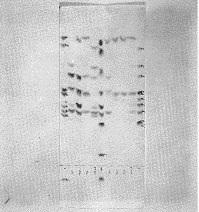 |
The amino acids that make up proteins can be separated and identified by the process of electrophoresis. The protein molecules are split chemically into smaller parts, then dissolved in a weak acid that upsets the delicate acid-alkali balance and put on a filter paper; An electric current is passed through the wet paper, separating the individual amino acids, which are carried different distances across the paper. They are then stained and labelled down the side of the, 'streaks' Arg for arginine, Lys for lysine and so on. |
Amino acids are the building blocks of which PROTEIN molecules are made, and are thus the basic structural material of all living matter.
Although there are literally millions of different proteins, there are only twenty amino acids. Their molecules are linked together in a large number of different ways, and often in huge numbers, to form a protein molecule. Haemoglobin consists of the protein globin which is formed of 74 amino acid molecules, and a complex organic compound, haem, that gives blood its red colour.
The bodies of animals are constantly using up protein through excretion, the growth of hair and nails and so on. As a result, they need a constant supply of amino acids which the body can use where required for energy, and can build into protein. They do this by taking in protein, hydrolyzing it (breaking it down) into separate amino acids through the action of enzymes in their digestive tracts, and rebuilding them into the proteins that are needed. Enzymes are themselves proteins, and function like CATALYSTS in the body to speed chemical reactions.
The twenty amino acids are valine, leucine, isoleucine, threonine, methionine, phenylalanirie, tryptophan, lysine, glycine, alanine, serine, cysteine, tyrosine, aspartic acid, asparagine, glutamic acid, glutamine, arginine, histidine and proline. Of these, the first eight are essential to man, since the body cannot synthesize them from other substances. A lack of any of them in the diet causes malnutrition. Vegetarian diets, unless very carefully planned, tend to lack some of the essential substances. The list of essentials varies slightly for different animals.
The general amino acid formula is R.CH.NH2COOH, with R standing for either a hydrogen atom (in the case of the simplest amino acid, glycine) or a more complex organic radical or group of atoms. This formula gives the amino acid an unusual property which makes it valuable in a living cell.
The formula contains both the acidic or carboxyl group,-COOH, and the alkaline or amino group, -NH2. When an amino acid molecule dissolves in water it ionizes (becomes an ION) but because the carboxyl group has a negative charge and the amino group a positive charge, the resulting ion is electrically neutral. This unusual kind of ion is called a zwitterion.
If a positively charged ion, such as a hydrogen ion (H +) from an acid, is introduced into an amino acid solution, it is attracted to the negatively charged portion of the amino acid zwitterion, neutralizing it and leaving it with only its positive charge. Similarly, a negative ion such as a hydroxyl ion (OH-) from an alkali is attracted to the positively charged portion of the amino acid molecule.
This ability of amino acids to collect any stray positive and negative (and therefore acidic or alkaline) ions allows theni to act as 'buffers' in living cells, maintaining the delicately balanced pH (a measure of acidity or alkalinity) which the cells must have in order to function.
Reproduced from HOW IT WORKS p89