|
How it works : Gravitation |
GRAVITATION
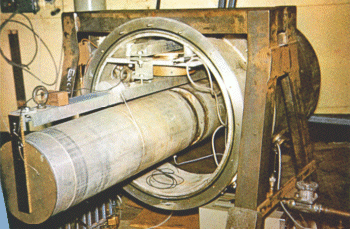 |
| Above: this apparatus to detect gravity waves monitors the position of a massive aluminium cylinder, normally in a vacuum. Claims that gravity waves have been detected have not been confirmed. |
We are accustomed to the idea that the force which causes objects to fall to the ground (and which we call gravity) is also the force which keeps the planets moving round the Sun, but this fact was not realized until the 17th century. The ancient Greeks thought that solid bodies fall because they are seeking their natural place (under the 'lighter elements' water, air and fire), while the planets are moved by invisible crystalline spheres. Even Johannes KEPLER, who proved in 1609 that the planets' orbits are ellipses around the Sun, thought that they must be moved by motions in the ETHER.
It was Isaac NEWTON who first realized that the planets would naturally move in ellipses if there was an attractive force between the Sun and the planets which depended on the product of the masses of the two bodies divided by the square of the distance between them. He showed that it was the same force which attracts an apple towards the Earth, by comparing the force on the apple with the force needed to keep the Moon in orbit about the Earth. Since the distances from the centre of the Earth to the apple, and to the Moon, were known he could demonstrate that these forces also depended on the inverse square of the distance-that is, the force decreases as the square of the distance increases.
Measuring gravity
The force of gravity is actually extremely weak (see FIELDs), and
it is only because the Earth is so massive that its gravitational effects
are obvious. The attractive force between two 20 kg (44 lb) objects 30
cm (1 ft) apart is only the same as the weight of one thirty-thousandth
of a gramme (one millionth of an ounce) on Earth. The first measurement of
gravitational force between two bodies of known mass was made by Henry
CAVENDISH in 1798.
His apparatus consisted of two 2 inch (5 cm) diameter lead balls (each weighing 1.7 lb, 0.75 kg) hung from the ends of a six foot (2 m) long deal beam, which was supported at the centre by a long wire allowing the beam to swing horizontally. Two 12 inch (30 cm) diameter lead balls (each weighing one sixth of a ton) were placed near the small balls on opposite sides, so that the gravitational attraction between each pair of large and small balls caused the beam carrying the latter to swing towards the large balls. The 12 inch balls were then moved to the other side of the small balls, making the beam swing the other way. The total swing measured at the end of the beam was 3/10 inch (8.5 mm), and from this Cavendish calculated the force between the lead balls. He expressed his results as the gravitational force between two 1 kg masses 1 metre apart, a quantity usually called G. Cavendish's value for G was the best for almost a century, and is within one per cent of the best modern value (0.00000000006673 newton, that is 6.673 x 10⁻¹¹ newton).
Newton's gravitational theory also predicted that all objects at the same place will fall equally fast towards the centre of the Earth. The ancient Greeks, in particular Aristotle, had maintained that heavy bodies always fall faster than lighter ones, but in 1590 Galileo disproved this hypothesis. According to the legend he dropped two objects of different mass from the Leaning Tower of Pisa, and they hit the ground simultaneously. There is actually a very slight difference in acceleration between light and massive bodies, but the Earth is so much larger that this is unnoticeable.
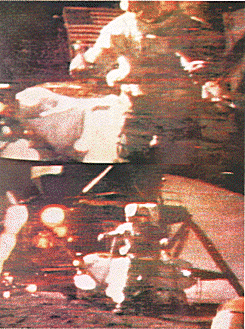 |
| Above: TV demonstration from the Moon's surface by David Scott of Apollo15. A hammer and a feather,dropped together,fell at the same rate in the airless conditions of the lunar terrain |
Variations in gravity
The acceleration due to gravity at any place is called 'g', and is about
32 feet per second per second (9.8 m/s2). It changes slightly
according to the altitude and latitude of place where it is measured. The
Earth acts gravitationally as if all its mass were concentrated at the centre.
It is not a perfect sphere, so a change in either altitude or latitude means
a change in the distance from the centre of the Earth, and thus a change
in the gravitational force (according to the inverse square law). At a height
of 100,000 feet (30,000 m) 'g' is 99% of its value at sea level. Even
at the altitude of an orbiting spacecraft, about 200 miles (320 km), the
gravitational force is still only 10%% less than at the surface.
But the spacecraft is given sufficient orbital velocity that CENTRIFUGAL FORCE exactly balances that due to gravity, and the astronauts experience weightlessness.
Einstein's General Theory of RELATIVITY (1915) introduced a new theory of gravity, which for everyday purposes is the same as Newton's, but it explained a puzzling discrepancy in the motion of the planet Mercury. Einstein's theory also predicted that light as well as matter is affected by gravity, and astronomical observations have proved that this effect does occur. Other predictions of the theory, such as the existence in space of 'black holes' (in which the gravitational field is so strong that light cannot escape) and gravitational radiation (in some ways similar to ELECTROMAGNETIC RADIATION) are still being investigated by astronomers. Another, more recent, theory, suggests that the value of G may change very slowly over the duration of the Universe, thus accounting for some of its large scale properties such as its apparent expansion.
Reproduced from HOW IT WORKS p1141