 |
So who's a clever boy then?
|
Dumb
animals? No way,says the concluding part of Clever
Dicks,which this week narrows the field for the title of animal
Mastermind
Gareth Huw Davies
 Caring
canines
Caring
canines
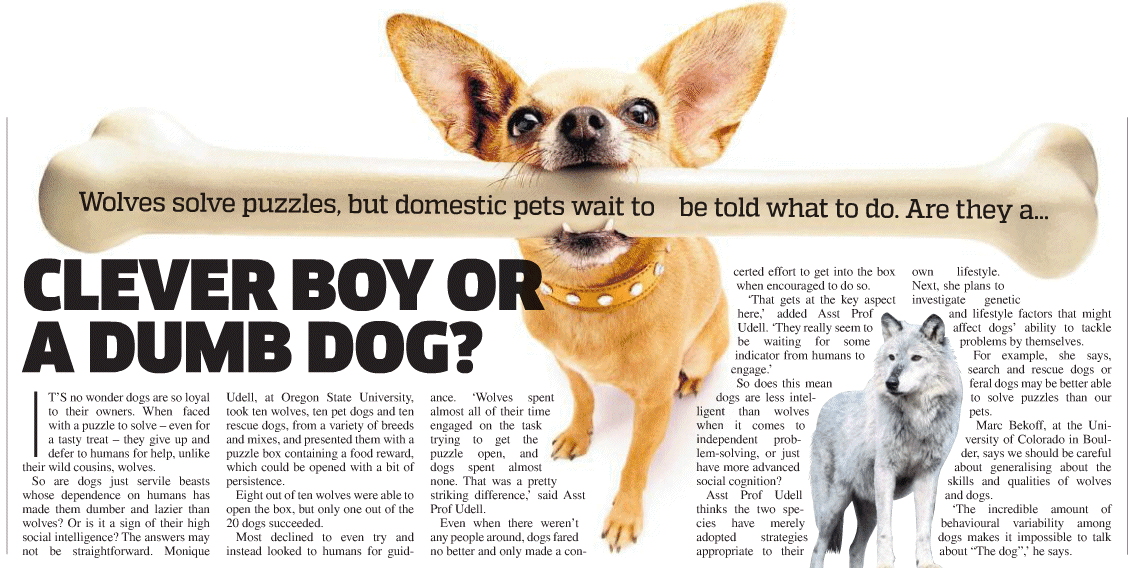
Dogs are descended from wolves. Breeders have isolated their
best, wild qualities, fast forwarded evolution with selective
breeding, and given us pooches that do the supermarket shopping
for disabled people and collect their money from the cashpoint.
The smartest seem to solve problems using insight, not purely by
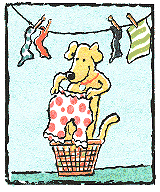
trial and error. In Clever Dicks, Frodo the labrador
loves washdays. He empties the washing machine for his disabled
owner Stephanie. Then he tugs the basket full of wet things into
the garden where he gently nudges them over to Stephanie to hang
up. Forgotten the pegs? Leave it to Frodo. And the busy housedog
still has time to open the door and let in the cat.
Literary lions
The clever, communal self-preservation strategy of some
Californian sea
lions is now a tourist attraction.They used to haul
themselves up on rocks, but the incoming tide had a habit of
invading their sleep. And great white sharks added a nightmare
dimension. Their solution is to bed down in safety on floating
pontoons in San Francisco harbour. The traditional image of the
circus sea lion - balancing a ball on its nose - is for losers.
Real sea lions read. They can tell their A, B, C from their
1,2,3. In a test they were shown a letter, and to win a fish
they had to press a board - the one with a (different) letter-
right; or a number - wrong. No need to phone a friend, or ask
the audience. They were right every time.
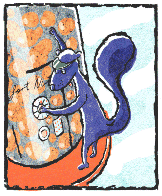
Safe -cracking squirrels
Grey squirrels are old troupers on the clever animals circuit.
You loved them in the BBC series Daylight Robbery. So
what keeps them at the top? Dexterous front paws, an amazing
curiosity for anything new, and a dogged determination to never,
ever give up. Where you see a bird-feeder full of nuts,
squirrels behold a feast that's just asking for freedom. In the
intelligence trials, garden squirrels were let loose to roadtest
the latest fiendishly ingenious bird feeding models, all
finished to Fort Knox standards of impenetrability. The
squirrels took a first-half drubbing but once they worked out
the defence, there was only one result. We can't wait for the
rematch.
Dexterous dolphins
In the wild they are credited with lifesaving, baby-sitting and
providing therapy
to sick people. In captivity they perform intricate
routines and understand complicated spoken instructions. It's a
product of their sociable nature and a long youth which is full
of learning. Give them the handbook and they could probably rule
the world. Captive dolphins were
shown a Perspex tank with a fish in
it. Two foreign objects were added -a weight and a pointy thing.
They worked out that putting the weight in the top of the box
released a trap door, which then allowed them to probe the
pointy thing into a panel, thus releasing the fish. Now the
dolphins want the real test to begin.
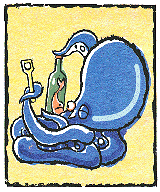
Arms and the octopus
Octopuses are the primates of the
undersea world, having the biggest brain of any invertebrate
(creature without backbone), with extremely sharp eyesight and
amazing memories. This puts them among the star problem -
solvers of the wild. They are also great cowards - the ability
to know when to run away is another sign of cleverness. So does
helping itself to a crab from a crab pot present much of a
challenge? Too easy. Squirming through a Perspex maze for a
fish? Piece of cake. In the end this touchy-feely cephalopod
was shown a fish in a bottle, which was inside a second bottle.
It gave it the full octo-twist and unscrewed both tops in
minutes to extract its tasty reward.
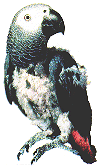
Precocious parrots
The kea, an alpine parrot from
the mountains of New Zealand, is a very bright bird indeed. It
will investigate anything new to see if it can he pulled out or
taken apart and maybe eaten. Tugging the laces from walkers'
boots is a speciality. Keas also have an interesting spin on car
maintenance. They can take visitors' cars apart - mirrors,
lights, hubcaps, wipers, the lot. A kea says: "This BBC geezer
turns up on our mountain with a tube full of little trapdoors.
We pull a few levers and some cheese falls out. Simple. We do
five more they thought were harder and harder. Easy. Last is
this long tube with eight rods to pull, levers to yank and
buttons to press. Took no time. Are humans stupid?"
|
Whose a clever boy then? Question How do parrots talk
or speak? Are their larynxes, tongues or brains
different to other birds? Margaret Turpin , Malborough
Wiltshire Answer Parrots are unusual. In
most birds, sounds are created by a set of vibrating
membranes in a pair of syrinxes
the lower larynx or voice organ in birds. One
is found at the top of each bronchus coming from the
lungs. But parrots have only one syrinx, situated at
the bottom of the windpipe just above where the two
bronchi meet. This is similar to humans, who also have
only one sound-producing organ: the larynx. Unlike
most other birds, parrots also have very long and
muscular tongues, which may be important in modifying
sounds. Using the throat, mouth and tongue, parrots
can alter dominant sound frequencies or "formants" to
give the sound they want to make. For example, a
parrot can make an "ee" rather than an "ah", sound by
opening its beak wider and pushing its tongue farther
forward. The parrot also has forebrain areas involved
in vocal learning and control of vocalisation that are
not found in other birds. Broad parallels can be drawn
with similar areas specialised to deal with language
in humans. That helps explain why parrots have such
versatile vocalisations, but there is a debate over
whether parrots can learn anything similar to
language. They can utter "sentences" consisting of
words in an order that makes grammatical sense.
However, it is unlikely that they are using syntax in
the way humans do. It seems far more probable that
they are following inflexible "rule-governed
behaviour": that is, they understand that a certain
order of sounds must be adhered to in order to achieve
the task in question. Much of the debate over the
level of parrot language ability has been driven by
the remarkable research of Irene
Pepperberg and an African grey parrot called Alex (New Scientist, 15
January 2000, p 40). With thanks to Erich D. Jarvis, ,
The department of neurobiology Duke University Medical
Center, Durham, North Carolina, US |
So who's a clever boy then? |
|
|
|
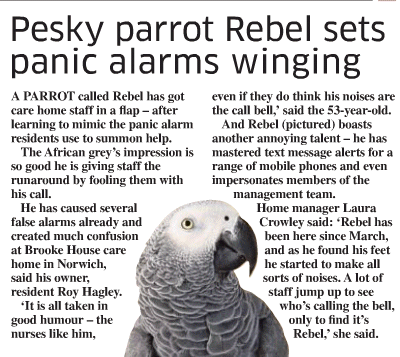
Parrot 'knows 950
words, cracks jokes and makes up sentences'
|
| N'kisi also has a dry sense
of humour. When another parrot hung upside down from its
perch, he apparently joked: 'You got to put this bird on
the camera'. He also associates photos with real people
or objects. When he first met primatologist Dr Jane
Goodall after seeing her pictured with apes, he
greeted her with: 'Got a chimp?' Dr. Goodall says N'kisi is an 'out-standing example of interspecies communication' - but new studies suggest his skills may not stop at verbal. In a test reported in next month's BBC Wildlife Magazine, N'kisi and Mr Morgana were put in separate rooms and filmed as she randomly opened envelopes containing picture cards. The bird, bred in captivity, chose appropriate words for the pictures three times more often than chance would allow. He even said: 'What ya doing on the phone?' to a picture of a man with a phone. Prof Donald Broom, of Cambridge University veterinary school, said: 'The more we look at the cognitive abilities of animals, the more advanced they appear.' [The Metro Jan27,2004] |
|
|
|
|